
Build Scott County's Deed Chain Backward
Open a blank transfer log instead of trusting a prewritten list of names. Each row records one supported step in the chain. The newest deed names the first prior owner. That person or entity then becomes the grantee you search for in the next earlier instrument.
| Transfer date | Grantor → grantee | Instrument | Book/page or number |
|---|---|---|---|
| Newest verified date | Prior owner → present grantee | Deed type shown by the record | Exact citation copied from the instrument |
| Next earlier date | Earlier owner → prior owner | Deed type | Exact citation |
| Continue backward | Repeat with each grantor | Deed, court-linked transfer, or estate instrument | Exact citation and source location |
Never fill a row from memory alone. An owner-history display proves nothing by itself. Match the legal description, acreage, lot and block, partial-lot language, and adjoining geography, and if the description changes, stop and check whether a split, combination, replat, or separate tract interrupted continuity.
Use Scott County's 1982 Online Boundary Correctly
The Scott County Recorder draws a firm line around online deed records. Everything from March 15, 1982 forward sits in Doxpop. Basic index information is free there. Detailed data and images cost a fee. The office also keeps indexing historical documents and uploads new entries weekly, so a no-result search before the 1982 start date does not mean the deed never existed.
The county's official online route is the Doxpop Recorder landing page, which presents the recorded-document service through a JavaScript interface that exposes no stable grantor/grantee result row, so rely on the live controls rather than a saved results table.
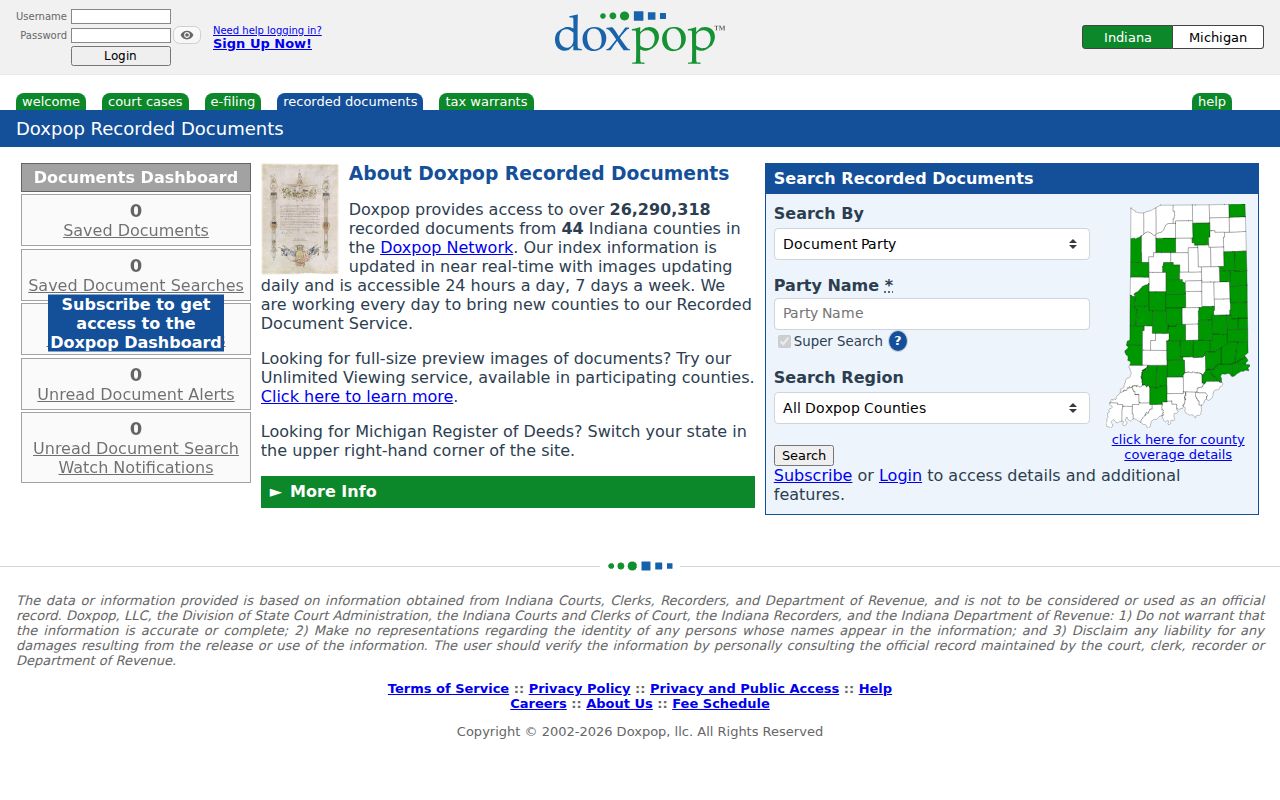
The live controls are what matter. Save the search date and spelling you tried, never invent a field, and never let an absent web result close the chain.
Coverage cutoff. Online Recorder coverage begins March 15, 1982; older former owners may require the courthouse, deed books, or State Library microfilm.
Reconstruct Scott County Ownership One Grantor at a Time
Backward is the only direction that works. Former-owner research starts from a verified current deed and moves one grantor at a time, logging spelling variants, dates, legal descriptions, and source citations as you go.
- Find the present owner’s acquisition deed and verify its parcel or legal description.
- Copy the grantor exactly, along with recording date, deed type, and book/page or instrument number.
- Search that grantor as an earlier grantee; test initials, entity variants, and reasonable spelling differences.
- Repeat until the search crosses the online boundary, then continue through the direct and reverse deed indexes and deed books.
- Grantor
- The party conveying the interest described by the instrument.
- Grantee
- The party receiving that interest.
- Reverse index
- An index organized from the grantee side, useful for finding how a former owner acquired the land.
- Chain of title
- The ordered sequence of recorded interests affecting the same property; an index-built research log is not a title opinion.
- Warranty / quitclaim
- Different deed forms whose legal effect depends on the instrument; neither label alone proves a complete chain.
Go Back to Scott County's Nineteenth-Century Indexes
The Indiana State Library's preliminary microfilm inventory opens the nineteenth century for Scott County deeds. Grantee and grantor indexes fill volumes 1–3, covering 1816–1887. Deed records A–B2 span April 1820 to March 1887. The same list records indentures from September 1847 through October 1890. Deeds dated 1819–1828 have indexes reaching 1820–1910. Another deed group spans 1820–1874.
The inventory labels these materials "Microfilm, Second Floor." It warns the list may not be current. Treat every range as a lead. Verify the reel, volume, county, and access conditions with the library or the Recorder before planning a trip. For in-person work, the Recorder counter sits at Suite 100, 1 E. McClain Avenue in Scottsburg, Monday–Friday, 8:30 a.m.–4:30 p.m., phone 812-752-8442.
Note: Weekly historical uploads make Scott County’s searchable boundary a moving target; date every negative search result.
Let Scott County's Legal Description Test Continuity
Street names change, rural routes become numbered addresses, and parcel identifiers get replaced after splits. The legal description is the real continuity test. Compare lot and block, subdivision or plat reference, metes-and-bounds calls, acreage, easements, and phrases like "part of." A deed for one partial tract is not the whole modern parcel without supporting records.
The Auditor keeps current plats. The Recorder holds the deeds and recorded plats. Together they show how a parcel changed shape. When a child parcel appears, trace its parent identifier and read the conveyance or plat that created the change. The Treasurer notes that recent splits and combinations may require a last-name search. That fallback works when a parcel number recovers nothing.
Use Two Scott County Maps as Name Clues
Two old maps can supply a buried name. The 1906 Steele and Draper map shows property owners, Scott County townships, and a Scottsburg inset, while a later Hixson plat book, dated roughly 1925–1940, maps land ownership and roads. Surnames older than parcel numbers can surface there.
Record the map date, image or page, exact name spelling, township, road geometry, and adjoining owner names. Then hunt those clues in the grantor/grantee indexes. Historic maps are snapshots. They do not do the legal work of a deed, so every suggested handoff still needs an instrument or plat connection.
Bridge Scott County Estate and Court Transfers
A buyer-seller chain can snap without warning. That happens when land moved through probate, divorce, partition, quiet title, or another court order. The Scott County Clerk is the local custodian for probate and related court files. Indiana MyCase offers public, non-confidential case information and some documents. Older or converted files may still require the Clerk.
Treat a case result as a pointer. A complaint or estate filing transfers nothing by itself. Capture the case number, parties, filing date, order date, and disposition. Then locate the recorded instrument or order tying the proceeding to the legal description. The Clerk sends abstractors to the office in person. Phone and email requests go unfulfilled. This route fills the gap without mistaking a court-party name for a deed.
Treat Austin's Owner History as a Lead
The Auditor's parcel record for 308 S Second Street, Austin, pairs owner-history dates with parcel 72-03-36-340-095.000-003. It also carries tax ID 0063640903 and a full legal description. It lists acreage, assessment figures, deductions, and any balance. That combination can seed the first rows of a research log. It also helps separate the right land from a same-name parcel.
The record cannot replace the deeds themselves. Pull the instrument behind each history date and compare grantor, grantee, and property description. Note one caution: fiscal fields answer no ownership question. A zero balance or a deduction is a fiscal result. It never proves the chain of title ran clean or complete.
Keep a Reproducible Scott County Former-Owner Log
Log every step. Record the searched name and variant, the source, the search date, and the date range. Add the instrument type, recording date, book and page or number, grantor, and grantee. Also record the legal description, parcel identifier, and image or reel citation. When an online search comes up empty, mark the gap. Use the phrase "not found in the searched coverage." That phrasing is honest. It never claims the record "did not exist."
The State Library guide reports no Scott County city directories in its collection. Skip any promise of a reverse-directory shortcut. For address history, lean on dated maps, newspapers, county histories, plats, and deeds. Keep each source's date and custodian with every entry.
Know How Far Scott County Ownership Evidence Reaches
Scott County's recorded ownership evidence reaches deep into the nineteenth century. Deed-index coverage begins in 1816, and deed records themselves begin around 1820. Coverage varies by series, though, and not every instrument has a matching image. Modern Doxpop access starts March 15, 1982, while historical indexing continues further back. The honest stopping point is simple. It is the oldest instrument you can verify for the exact legal description. That is not the same as proof that every earlier owner has been traced.
The Recorder does not perform title searches. Staff are not bonded for that work, either. When the chain of title matters, bring your research log and official copies to a qualified title professional. That matters for a closing, a lawsuit, an inheritance, or a boundary dispute. The Scott County deed records page covers instrument access in more depth. The current owner page stays focused on today's roll.
Index limit. A reconstructed list of former owners supports house history and property diligence, but it is not a title opinion and must not be used to track or harass anyone.