
Know Scott County Deed Records
A deed conveys interest, while a mortgage secures debt and a release ends a recorded claim. The Recorder also files assignments and plats. Pull the recorded image whenever legal effect matters.
| Deed Type | What It Does | Common Use |
|---|---|---|
| Warranty deed | Conveys land with stated covenants | Conventional sale transfer |
| Quitclaim deed | Conveys whatever interest the grantor holds | Family or corrective transfer |
| Trustee or representative deed | Transfers in a representative role | Trust or estate transaction |
| Mortgage | Records a security interest | Identify the original lien |
| Release or assignment | Ends or transfers a claim | Follow a later instrument |
Blanket assignments and releases are not accepted. Scott County wants each instrument filed individually, so review every document touching the same tract.
Scott County Deeds Since 1982
The Recorder Services page places documents filed from March 15, 1982 forward in Doxpop's online index. Basic index facts are free. Deeper data and images carry fees. Historical indexing is uploaded weekly, so the cutoff for older records can shift.
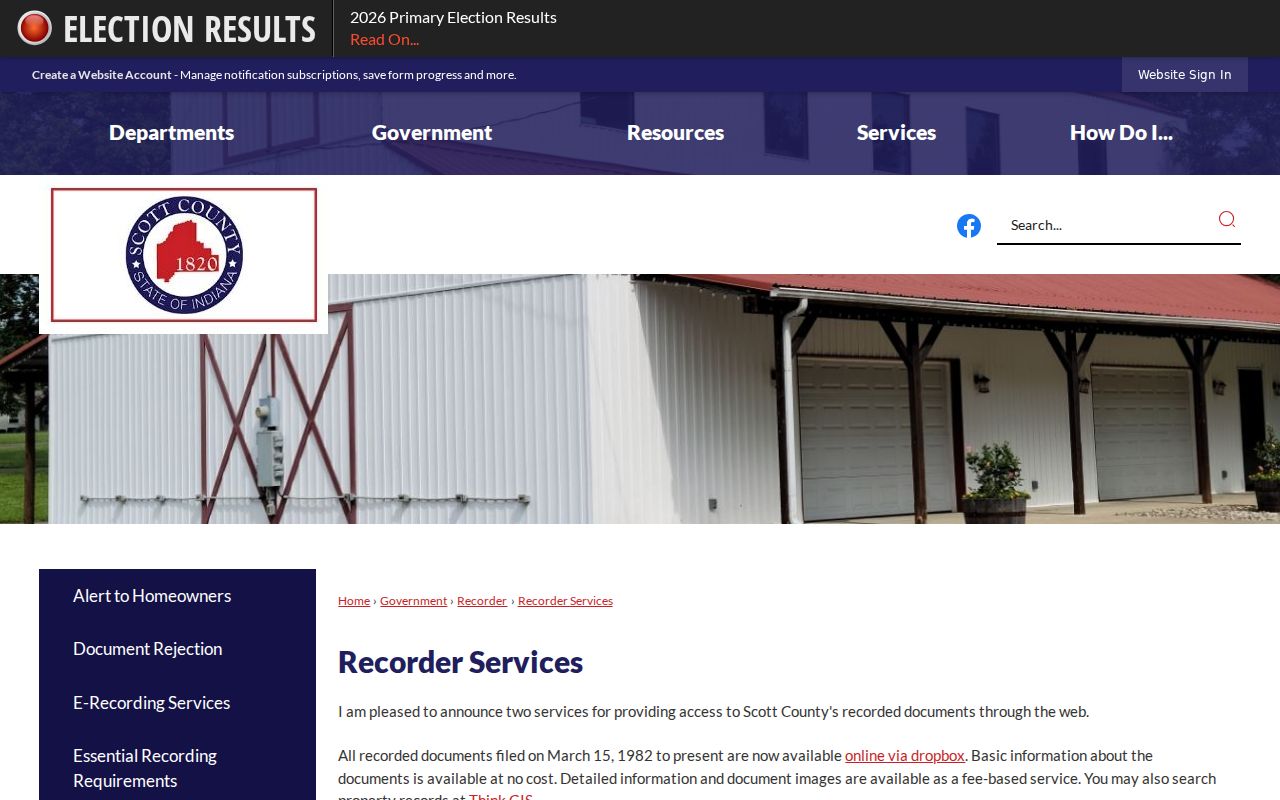
A pre-1982 miss may only be a coverage gap. Rather than assume no deed exists, record the search date and ask which book covers the period.
Use Scott County Doxpop
The county-linked Doxpop Recorder portal is the remote index for modern Scott County deed records. Its landing page names the service plainly. The search form runs on JavaScript. Field labels appear only in the live controls, so rely on the page itself rather than assuming a search mode.
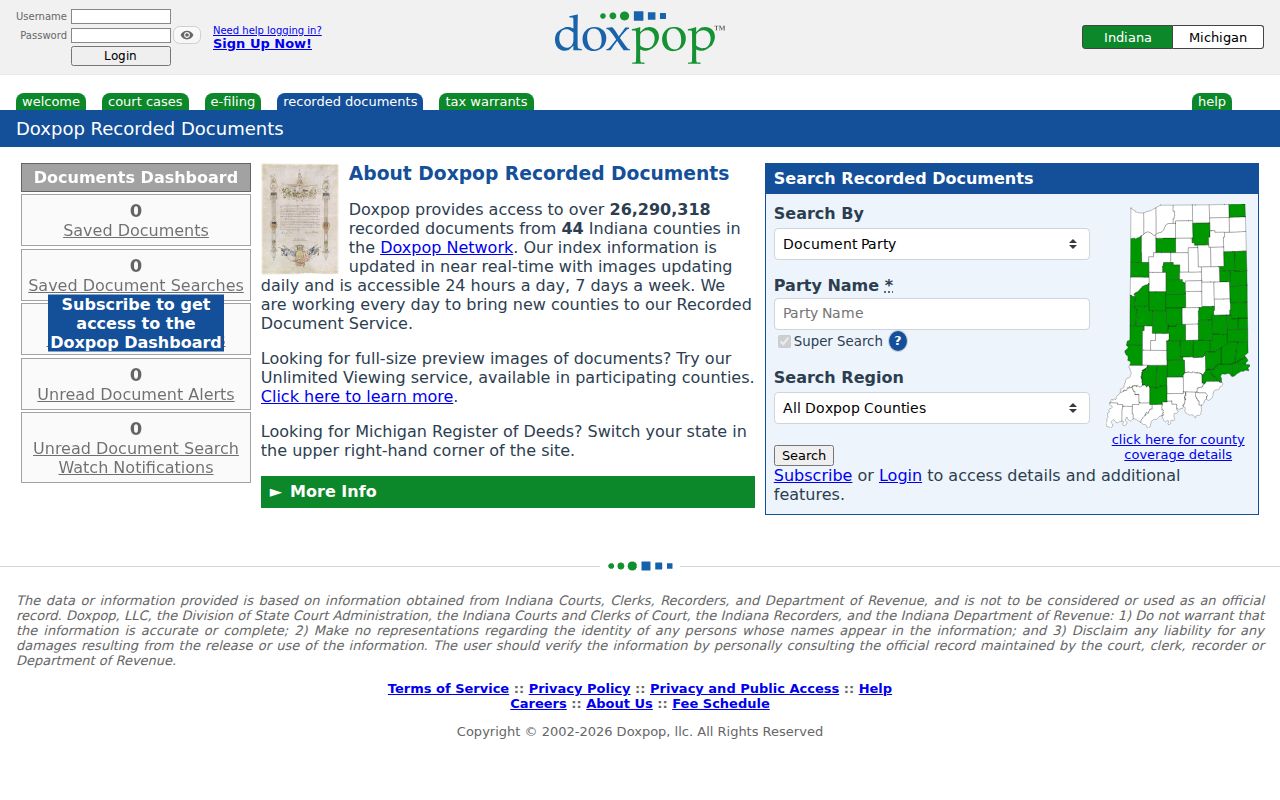
Confirm names, dates, and legal description before buying any image. Save that instrument reference for later chain work.
Trace Scott County Deeds Backward
A grantor gives and a grantee receives. That pairing builds a chain of title, the linked sequence of transfers for one tract. Start with a deed you know.
- Find the latest plausible deed with the current owner as grantee.
- Record its grantor, date, reference, and full legal description.
- Search that grantor as a grantee in the earlier period.
- Compare lots, acreage, exceptions, and plats before accepting the link.
- Grantor
- The party conveying an interest.
- Grantee
- The party receiving an interest.
- Chain of title
- The linked sequence of land transfers.
- Book/page or instrument number
- The citation used to retrieve the recorded item.
Find Early Scott County Deeds
The Indiana State Library Scott County research guide and microfilm list reach beyond the current portal. The list includes grantor and grantee deed indexes, volumes 1 through 3, for 1816 through 1887, plus deed books. Confirm the exact reel and volume before ordering or visiting.
A 1906 property-owner map and a Hixson plat book from about 1925 to 1940 can supply name, road, and neighbor clues. They do not transfer title. Pair each map clue with the recorded deed chain.
Match Scott County Legal Descriptions
A street address can change over time. The legal description is what ties a deed to land, and one Auditor example shows partial-lot wording for Block C of Allendale. Copy such abbreviations exactly. The Auditor keeps current plats, while the Recorder holds the recorded plats and deeds.
Scottsburg's UDO adds a telling sequence: approval, recorded plat or replat, parcel creation, then later deeds and tax records. A notice alone proves no recording.
Get Scott County Deed Copies
Doxpop images can require payment. The courthouse fallback is the Recorder, Suite 100, 1 E. McClain Avenue, Scottsburg, Indiana 47170, reachable at 812-752-8442. Office hours are weekdays, 8:30 a.m. to 4:30 p.m. Recorded originals are returned by mail. A self-addressed stamped envelope is required.
The county's homeowner warning contrasts an $86 private deed solicitation with the Recorder's general $1-per-page route, which often totals $2 or $3. Call the official office before paying anyone for a routine copy.
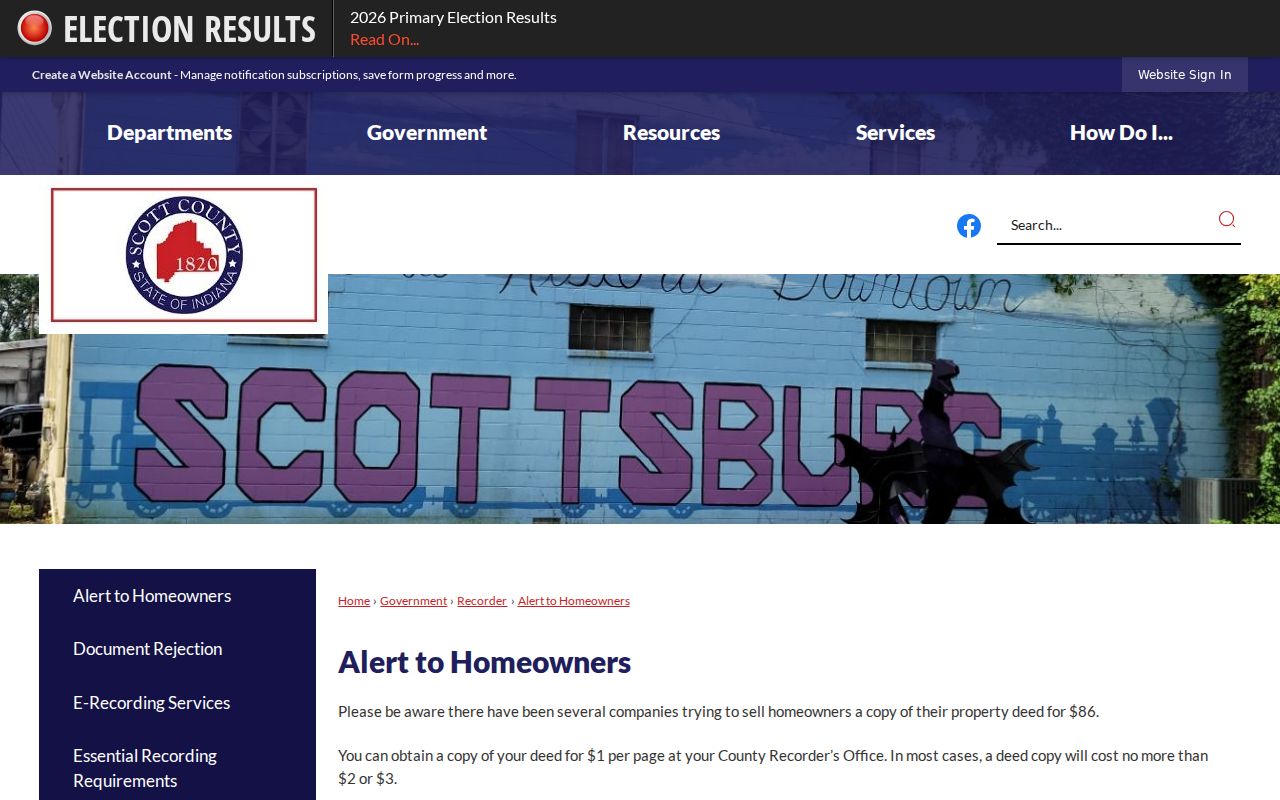
The alert shows why source and fee checks are part of safe deed research.
Recorded, not guaranteed. The index shows what entered the recording system; it is not a title opinion, and interests may exist in other systems.
Meet Scott County Filing Rules
Most instruments need notarization, printed or typed signer names, and a prepared-by statement. Deeds and title changes require Auditor endorsement. Social Security numbers are barred from most recordable documents, with limited exceptions, and the county requires a redaction affirmation.
Regular documents run 8.5-by-11 to 8.5-by-14 pages. Plats and surveys use larger Mylar sizes. Formatting decides acceptance for recording, not whether the claimed interest is valid.
Respect Scott County Deed Limits
The Recorder does not run title searches. Scott County warns that judgments, state tax liens, and bankruptcies are not always filed with the Recorder. Court, tax, and federal records can still matter. Indiana's APRA, IC 5-14-3, opens existing public records subject to listed exceptions. Ask for a known instrument. A name, a date span, and a land description work better than a request for a new report or legal opinion. Starting from an address instead? The Scott County property search maps an address to its parcel first.
Military discharge records sit in a separate protected category. Scott County treats DD-214 records as confidential under IC 10-17-2-4, effective since May 15, 2007. Photo identification and eligibility limits apply. Social Security numbers are also restricted in ordinary recorded instruments. These are access limits, not indexing gaps.
Business collateral can point outside the county system. Since July 1, 2001, personal-property financing statements file with the Indiana Secretary of State, not the Recorder. Keep a Scott County deed or mortgage search aimed at recorded land instruments. No county search should be called a complete sweep of every claim tied to a person or company.
End every deed review with a simple audit trail. Log exact search names, roles, date spans, instrument references, image source, legal-description matches, and unresolved gaps. If an instrument depends on a probate order, judgment, release, survey, or plat, retrieve that source instead of inferring its contents. A clean log speeds later courthouse work.
Audit Scott County Deed Matches
Give every match one final pass. Compare grantor and grantee spelling, execution and recording dates, the instrument or book reference, and the legal description. Partial-lot wording rarely matches a street address cleanly. An assignment or release belongs with the mortgage it affects, not on the ownership side of the chain.
For early Scott County deed records, note the index volume and page before requesting the deed book. The State Library microfilm list is a finding aid. The Recorder stays the county custodian. Because historical Doxpop indexing uploads weekly, a dated search log can explain why an older result appears later.
Connect Scott County Deed Events
Deed chains branch. An estate, divorce, quiet-title order, tax sale, mortgage release, easement, or parcel division can all split one line into two. When the index points to such an event, pull the related source rather than inferring the gap. The Scott County Clerk holds probate and civil case files. MyCase supplies public non-confidential case information and some documents. The Recorder then supplies the land instrument that was actually recorded.
Tax-sale research needs special care. A published list marks one stage in a statutory process. The certificate purchaser does not become the deeded owner at the sale. Confirm the judgment and notice. Confirm the certificate. Confirm the redemption deadline, any redemption, and the later tax deed before adding a name to the chain. Planning notices deserve the same caution. Scottsburg's PC-1-22 notice was a hearing lead. It was not proof that a final plat was approved and recorded.
Scott County recording rules explain why a rejected or missing instrument needs follow-up. Deeds and title changes need Auditor endorsement. Most documents require notarization, printed signer names, a prepared-by statement, and a redaction affirmation. Originals come back. A self-addressed stamped envelope is required for return. These intake rules test whether a paper was fit for recording. They never decide the validity or priority of the interest claimed inside it.
Date Scott County Deed Images
Log the date and access route for each image. Basic index facts may be free while detailed data or images can require payment, and an office copy serves a different need than a portal view. Keep the source with the reference.